
Return To Blog Listings
Most care home operators hear the word "branding" and think of logos. Maybe a colour scheme. Perhaps a tagline that took three months to agree on and now sits at the bottom of a letterhead nobody reads.
That is not what branding is. And the gap between that understanding and what branding actually does is costing care homes enquiries every day.
This article explains what care home branding genuinely means, what it is made of in practice, and why it has a direct and measurable effect on whether families add your home to their shortlist before they have ever spoken to anyone there.
What Branding Actually Is
Branding is not a visual exercise. It is the impression your home leaves on a family at every point of contact before, during, and after their first enquiry.
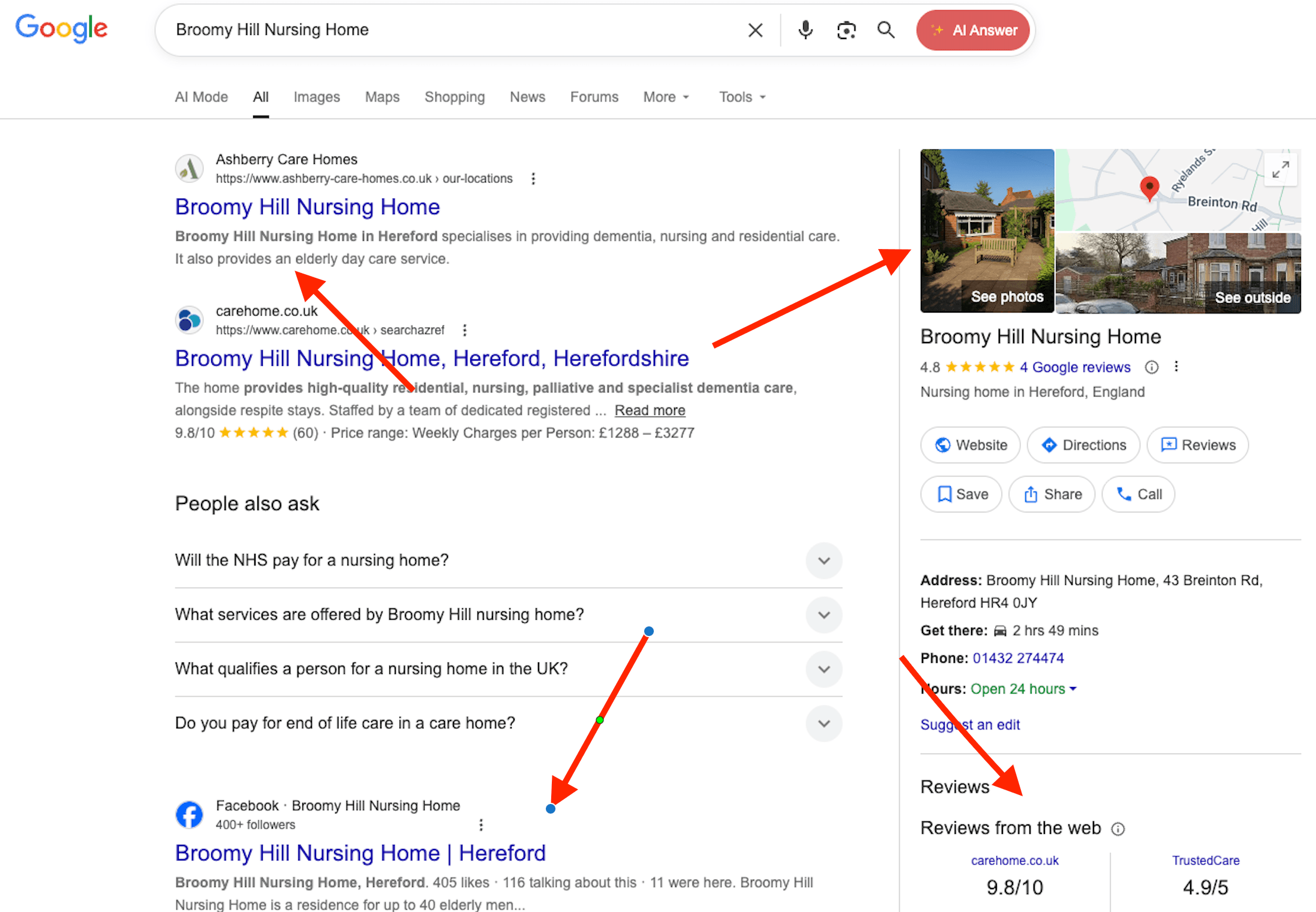
When a family googles care homes in your area, they do not experience your logo. They experience a search result, a Google Business Profile, a set of photographs, a first paragraph of website copy, and a collection of reviews. Every one of those things contributes to a single question the family is unconsciously asking: does this home feel like somewhere I could trust to look after my mum?
That feeling is your brand. The logo is just one small part of how it gets communicated.
"Operators often come to us having spent money on a new logo and wondering why enquiries have not moved. The logo was not the problem and was never going to be the solution. Branding in care is about whether a family feels safe making contact. Everything else is secondary."
Mat Stuckey, SEO/GEO Lead at Care Launch
A care home with a strong brand is one where:
- The photography feels warm, real, and specific to that home
- The copy on the website sounds like a person who cares, not a compliance document
- The reviews tell a consistent story about how staff treat residents and families
- The Google Business Profile is active, up to date, and visually coherent
- Every touchpoint, from the website to a response to a negative review, reflects the same values
None of that requires a rebrand. It requires intention.
Why Branding Affects Shortlisting
The shortlisting stage is where branding does most of its work. Families searching for care homes are not conducting a formal procurement exercise. They are making one of the most emotionally significant decisions of their lives, often under time pressure, and with limited ability to verify the claims any home makes about itself.
In that context, perception becomes the proxy for quality. A family cannot assess the clinical competence of your nursing team from a website. They cannot verify your CQC inspection outcomes are genuine until they look them up. What they can do, instantly and instinctively, is decide whether a home feels right.
That feeling is constructed from dozens of small signals, most of which arrive before the family has any direct contact with your home. The photography tells them something. The way your homepage is written tells them something. Whether your Google Business Profile has been updated recently tells them something. Whether the registered manager has replied to reviews tells them something.
Each of those signals is either building a case for your home or undermining it. The homes that get shortlisted consistently are the ones where the signals add up to a coherent, trustworthy picture.
What Care Home Branding Is Actually Made Of
Branding in the care sector is not one thing. It is a set of components that work together to create the impression a family forms of your home. Understanding each one makes it easier to identify where the gaps are.
The most important of these to get right before anything else is photography. No amount of well-written copy compensates for photography that looks institutional, dim, or generic. Families are making an emotional decision. They need to be able to picture their relative living there. Real photographs of real spaces, real staff, and real life at your home are the single most powerful brand asset you have.
The second is tone of voice on your website and in your communications. Many care home websites read as though they were written by a committee trying to avoid saying anything that could be questioned at an inspection. Families notice. They are looking for warmth, directness, and evidence that the people running the home understand what families are going through. A home that communicates like a human earns more trust than one that communicates like a policy document.
The Difference Branding Makes at the Shortlisting Stage
Consider two care homes in the same town. Both are rated Good by CQC. Both have broadly similar fees. Both have a website.
Home A has professional photography showing residents in the garden, staff by name, and activity sessions in progress. The homepage copy opens with a direct statement about what the home stands for and who it is for. The Google Business Profile has 47 reviews averaging 4.7, and the manager has replied personally to every one. The most recent post was two weeks ago.
Home B has stock photography, three paragraphs of generic copy about "person-centred care," 11 reviews averaging 4.1, and no replies to any of them. The last Google post was eight months ago.
A family searching online will shortlist Home A. Not because it is necessarily a better home. Because it looks like one.
This is the commercial reality of branding for care homes. It is not about aesthetics. It is about whether the signals your home sends out match the quality of care you actually provide. Many excellent homes are losing enquiries to competitors with stronger branding simply because the families searching never get far enough to find out how good the care is.
What Consistent Branding Looks Like Across Channels
A common mistake is treating each channel as a separate exercise. The website gets a refresh. The Google Business Profile gets some attention for a few weeks. The Facebook page gets occasional posts. None of it is connected.
Families do not experience your home channel by channel. They move between them fluidly. A family might find you on Google, visit your website, check your Facebook page, read your reviews, and then look at your CQC report, all in a single session. If each of those touchpoints looks and sounds different, the impression is fragmented. Fragmented impressions do not build confidence.
Consistent branding across channels means:
- The same photography used across your website, Google Business Profile, and social media
- The same tone of voice in your web copy, your social posts, and your review responses
- The same core message about what makes your home distinct, present on every platform
- Visual consistency in how your home name, colours, and any imagery are used
This does not require a large budget. It requires a decision about what your home stands for and a commitment to communicating that consistently.
"The care homes that build the strongest local brand presence are almost always the ones where the registered manager is personally invested in how the home presents itself online. It is not about marketing budget. It is about whether someone at the home genuinely cares what families see when they search."
Mat Stuckey, SEO/GEO Lead at Care Launch
How To Know Whether Your Branding Is Working Against You
Most care home operators do not audit their own brand from the perspective of a family searching for the first time. It is worth doing. Search for your home name in Google as if you were a family who had just been told a parent needs residential care. Look at every result on the first page. Read your own website copy as a stranger. Check whether the photographs on your Google Business Profile are current and specific to your home.
If any of what you find gives you pause, that is useful information. It means a family searching right now is having that same reaction, and in most cases they will move on to the next home on the list rather than dig deeper.
Strong branding does not guarantee enquiries. But weak branding guarantees that some of the families who find you will not contact you. At a self-funded fee of £1,200 to £1,500 per week, each of those unconverted visits represents a significant missed opportunity.
The good news is that the gap between where most care homes are and where they need to be is not as large as operators often assume. Photography, copy, and review management are the three highest-impact areas, and all three are entirely within the control of the home.
We work with care homes across the UK on exactly this, helping them build a brand presence that accurately reflects the quality of care they provide and converts more of the families searching into enquiries. Find out more about how we work with care homes or take a look at what good care home website design looks like in practice. If you are ready to talk through what this looks like for your home, get in touch and we will take it from there.
